

Do People Actually Believe What You Say?
The gap between what your brand claims and what people actually experience is where reputations get made..
or quietly eroded…
Most brands and organisations have a brand bible, a guide for how their image and voice should show up in the world. Many believe they’re doing a solid job sticking to it across the channels they’ve chosen to appear in. But very few can genuinely measure whether it’s actually landing.
Believability goes beyond awareness, reach, share of voice, tier-one hits, and other metrics you’re probably tracking already. We’re now able to give you a real metric that shows the degree to which what your brand claims is actually backed up by what people experience, what they say, and what they can see you doing in the world.
That gap between claim and reality is where reputations are made or quietly eroded. In working with brands and organisations. across Asia and Australia, it's a gap that most organisations underestimate until something forces them to look at it directly. Which is why we built the Believability Framework.
What it is:
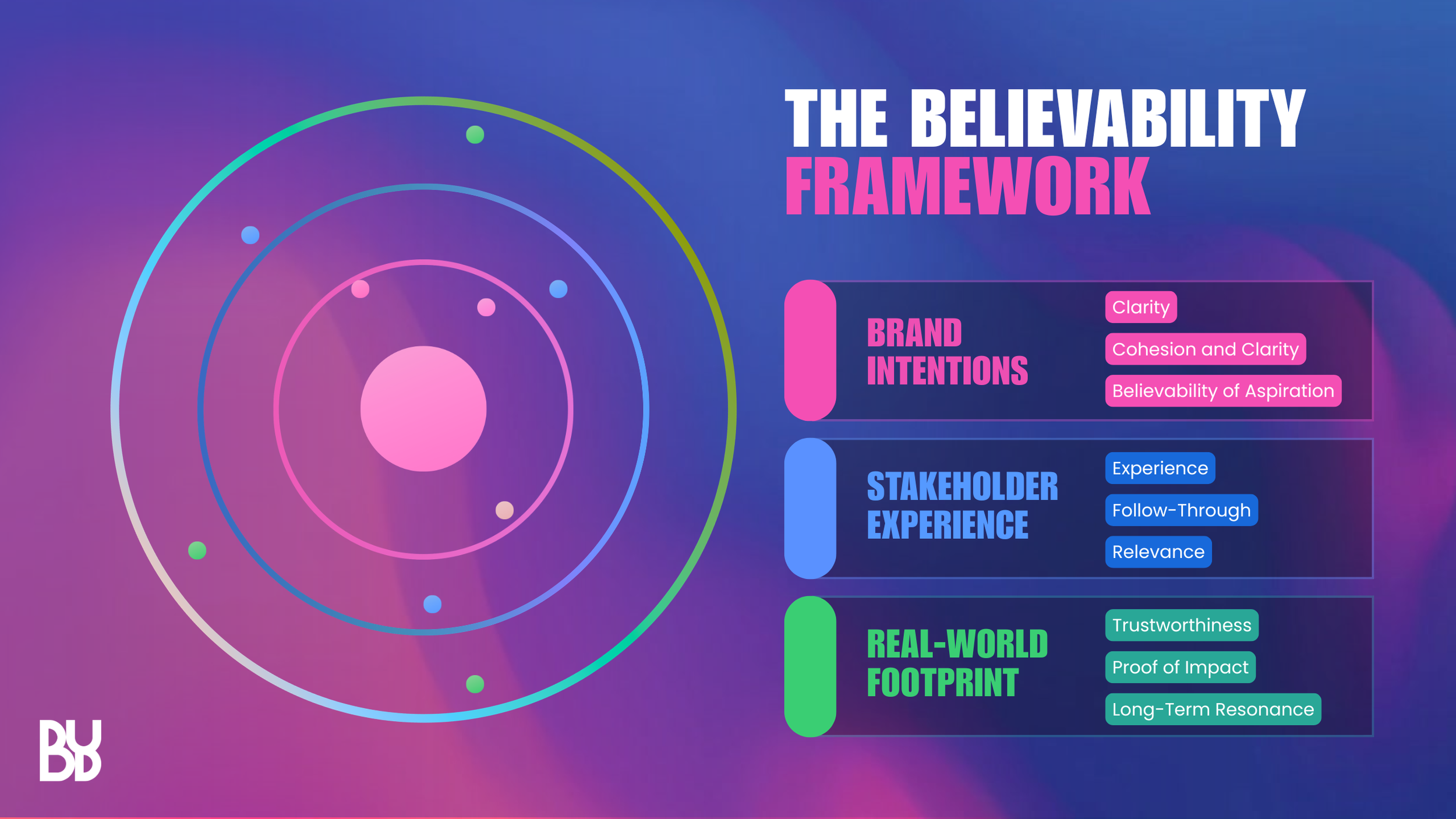
The Believability Framework is Bud's proprietary tool for evaluating how credible a brand truly is. We look at a brand across three dimensions:
Brand Intentions — what the brand is actually saying about itself, and whether that story is clear, consistent, and credible.
Stakeholder Experience — what people actually encounter when they interact with the brand, and whether that experience genuinely reflects what the brand claims.
Real-World Footprint — the external evidence of impact, the demonstrated trustworthiness, the long-term resonance that tells you whether a brand is walking the talk.
Across those three dimensions, we score brands against up to nine criteria, each rated on a scale from Very Weak to Excellent. We now have a number to display a clear picture of where a brand's believability is strong, where it's fragile, and where the strategic white space is. And it maps out the work to be done to close the believability gap.
How we use it
The framework is both an internal tool and an external one. It shapes how we approach our work with clients. It gives us a common language for what we're trying to build, a rigorous basis for the recommendations we make, and a way to measure progress over time rather than just activity.
Externally, it gives clients something they often struggle to find, a way to justify integrated communications investment to their stakeholders. Not just "we need more PR" or "we should do more thought leadership," but a scored, evidence-based assessment of where the brand stands and what closing specific gaps is worth.
We now use it at three points in the client relationship: during major planning cycles, in reporting, and in new business conversations where a brand needs to understand its starting position before it can plan its next move.
The crisis layer
One of the things we've learned from applying the framework across markets and industries is that it functions as a remarkably accurate predictor of crisis resilience.
Many communicators think a crisis event is simply a communications problem and can be managed as so. But the truth is, it only reveals communication issues that would have been there long before. The brands that navigate difficult moments well and that come through with their credibility intact, sometimes even strengthened, are almost always the ones that score well across the framework's dimensions before the crisis arrives. Their stakeholders already believed them because their story was already consistent and their track record already spoke for itself.
The ones that struggle tend to find out under pressure that their believability was thinner than they realised. The gap between what they claimed and what could actually be demonstrated became the story, precisely when they needed their reputation to do the most work.
We now apply a crisis lens to the framework as a specific use case and it helps clients understand not just where their brand stands today, but how resilient that position is when it comes under pressure. The adage that crisis is best managed by prevention is true – and being prepped and seeing, fixing gaps where they are provides the best chance of coming out of them unscathed.
Why this matters now
We're operating in an environment where trust in institutions is under sustained pressure, where audiences are more sceptical than they've ever been, and where the tools available to produce brand communications have never been more accessible or more generic. In that context, believability is a competitive advantage. An organisation that has genuinely closed the gap between what it claims and what it demonstrates doesn't just communicate better, it compounds credibility over time in a way that paid reach simply cannot replicate.
The Believability Framework is how we help clients understand where they actually stand, and build from there.
What a Believability Audit looks like in practice
Every audit is tailored to the client, from the market they're operating in, the audiences that matter most, and the strategic questions they're trying to answer. We draw on client-owned data, publicly available information, our own monitoring and research tools, and industry-level benchmarks to build a picture that is evidence-based rather than impressionistic.
The output is a scored assessment across the nine criteria, a clear narrative explaining what the scores mean in context, and a set of prioritised recommendations for where to focus effort and why.
For clients preparing for a major planning cycle, entering a new market, or navigating a period of change, it tends to be one of the most clarifying pieces of work we do together.
Ready to understand your brand's Believability?
Talk to us about auditing your brand 👇