
Inside the Bud Believability Framework: The Truth About How Your Audience Experiences You
Most brands have versions of themselves that they present in decks, internal meetings, and town halls. That version is one that they could strongly believe in, and one that really exemplifies what their brand stands for. Stakeholders will never meet that version of the brand, though. What they’ll meet is the version that comes up on a press release, appears on their social media feed, or replies (or doesn't) to a bad review.
That gap between the brand that a company presents and the brand that people actually run into is what Stakeholder Experience measures. It's the second pillar of Bud's Believability Framework, and it picks up right where Brand Intentions leaves off: the moment a brand's story stops being something it controls and starts being something other people test against their own experience.
That's also what makes it harder to manage. A brand can write its own intentions. It doesn't get to write stakeholder experience. The most a brand can really do is set the conditions and hope the experience holds up to the intention.
We score Stakeholder Experience across three criteria.
“The claim and the encounter are judged side by side — and stakeholders trust the encounter.”
Experience
Experience is about whether a stakeholder's lived encounter with a brand matches what that brand says about itself.
Gaps in experience are often not done on purpose. They're just things a brand wasn't able to give full attention to - but should.
A brand's website might say it's committed to sustainability and mean it, but still lose the argument once a customer opens the box and finds the same plastic wrap as before. The claim and the encounter are being judged side by side, and stakeholders trust the encounter.
Follow-through
Follow-through evaluates whether a brand's promises are backed by evidence that they actually happened.
Saying that you'll deliver something and actually delivering it are two different events, separated by time, and it's in that gap that most credibility is won or lost. The scoring question the toolkit uses is blunt: can the brand point to specific, verifiable proof that it did what it said it would do?
A simple way to see this is to lay commitments against outcomes directly:
Commitment: "We'll publish an annual business and performance report"
Outcome: Published, but two years late, missing the prior year's figures
OR
Commitment: "We've launched a new product that will deliver more benefits to our customers"
Outcome: Launched, but no public update on performance or results since
Neither line is severely damaging on its own, but together they start to describe a brand that announces more than it closes out.
Relevance
The last criterion under Stakeholder Experience, relevance, looks into whether a brand actively engages with what its audience actually cares about today, as opposed to only highlighting what the brand wants them to care about.
If brands don’t partake in conversations that are relevant to their target customers, they may just slowly stop engaging.
It's possible to be clear, consistent, and still be talking into an empty room if the topic isn't one that anyone is listening for. A brand's own agenda and its audience's agenda can drift apart quietly, usually because the brand is the last one to notice.
What a sample scorecard might reveal
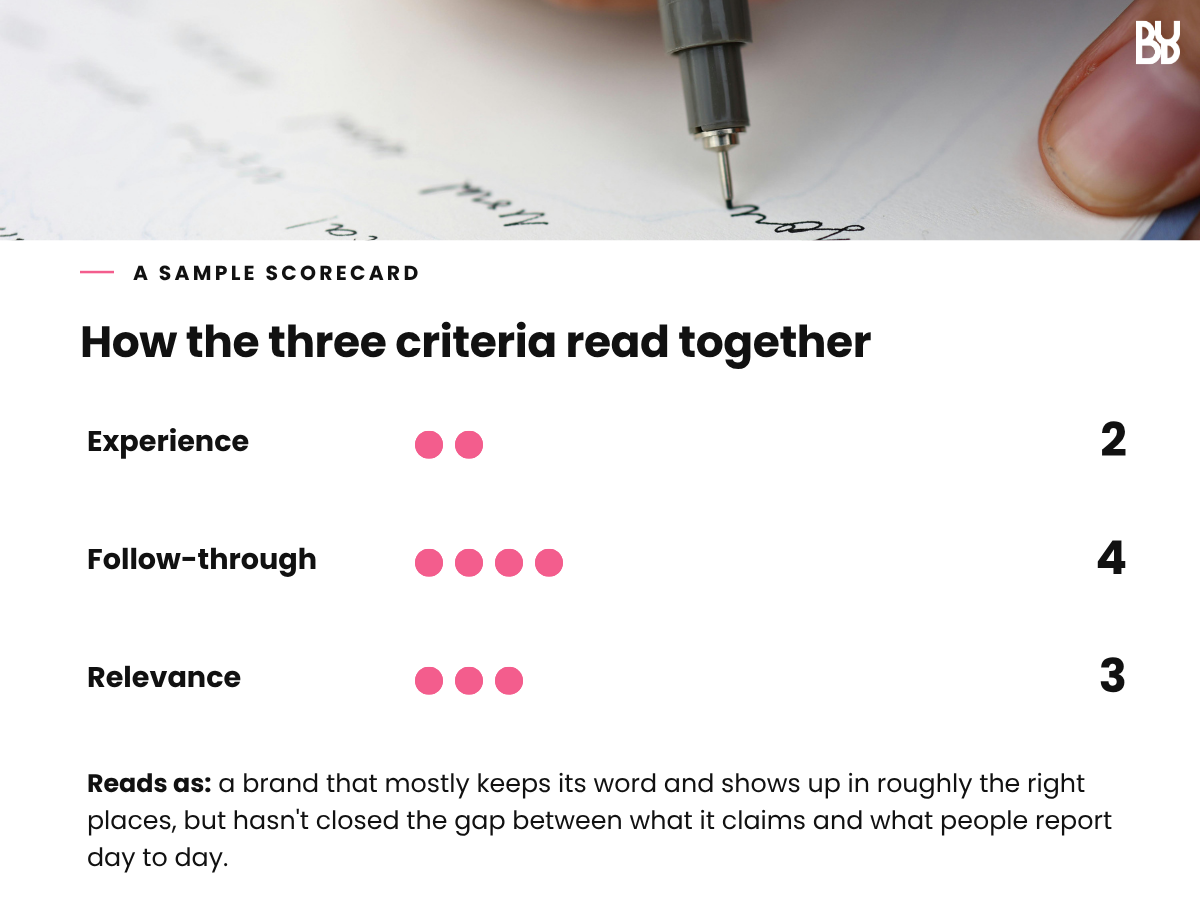
Scoring these three criteria produces a profile, not just three separate numbers. Here's an example:
What does this suggest?
Experience: Reviews and internal claims are telling different stories
Follow-through: Commitments are usually backed by visible outcomes
Relevance: Present in some of the right conversations, not consistently
A profile like this points somewhere specific. This isn't a brand in crisis. It's a brand that mostly keeps its word and shows up in roughly the right places, but hasn't closed the gap between what it claims about the experience it offers and what people are actually reporting day to day. That's a fixable, well-defined problem, and a very different one from a brand with no track record to point to at all.
Getting Experience and Follow-through right proves a brand can be trusted in the room. From there, the last question to ask is: what does the record actually show about my brand? How is it being painted out in the world, and over time? That's the layer Real-World Footprint measures against.
Curious how your brand's story holds up against what stakeholders are actually experiencing? Talk to us below.
